
Universitas Andalas Advances Global Scientific Collaboration through ICBSA 2026 under the EQUITY Program
Padang, 01 July 2026
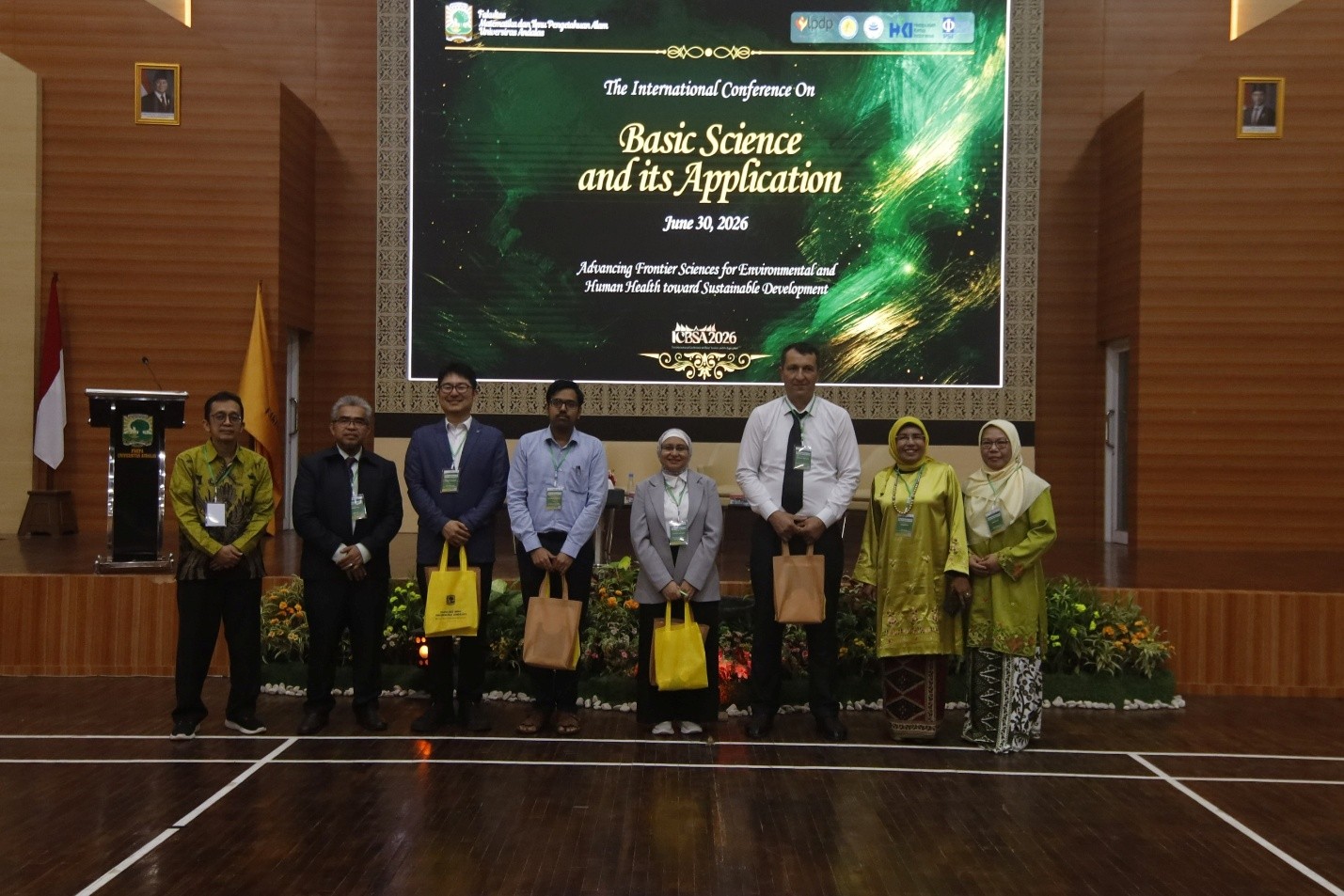
Padang — Universitas Andalas, through the Faculty
of Mathematics and Natural Sciences (FMIPA), successfully organized the
International Conference on Basic Science and Its Applications (ICBSA) 2026 as
part of the Enhancing Quality Education for International University Impacts
and Recognition (EQUITY) Program. The conference strengthened Universitas
Andalas’ commitment to advancing basic sciences, international research
collaboration, and science-based solutions for sustainable development.
ICBSA 2026 was held on 30 June 2026 at the Tahir
Foundation Building, Universitas Andalas, Padang, under the theme “Advancing
Frontier Sciences for Environmental and Human Health toward Sustainable
Development.” The conference brought together academics, researchers, students,
and practitioners to exchange scientific knowledge and explore
interdisciplinary approaches to environmental sustainability, human health,
renewable energy, biodiversity, green chemistry, data science, and other
emerging areas of basic and applied sciences. 
The conference was designed to encourage
interdisciplinary collaboration among chemistry, biology, physics, mathematics,
and informatics. It also aimed to strengthen international research networks,
increase the research capacity of lecturers and students, and generate
internationally recognized scientific publications that contribute to
Universitas Andalas’ global academic visibility.
Six distinguished speakers from six countries
contributed to the scientific program: Prof. Dr. Marzuki from Universitas
Andalas, Indonesia; Asst. Prof. Aavishkar C. Katti from MIT World Peace
University, India; Prof. Masaji Watanabe from Okayama University, Japan; Prof.
Dr. rer. nat. Reham Helwa from King Salman International University, Egypt;
Prof. Dr. rer. nat. Sharofzoda Farrukh Safolbek from the Academy of Sciences of
Tajikistan; and Prof. Yang In Ho from Korea Maritime and Ocean University,
South Korea.
The conference included plenary sessions,
scientific discussions, oral presentations, poster presentations, and awards
for the best presenters. Oral presentations were organized in ten parallel
rooms according to scientific disciplines, while poster presenters engaged
directly with evaluators and participants to explain their research findings
and receive scientific feedback.
The activity report records approximately 300
participants attending the conference, highlighting strong interest in basic
sciences and their applications for addressing contemporary challenges.
Discussions throughout the conference focused on the advancement of science and
its applications for human health, environmental sustainability, technological
innovation, and sustainable development.
The conference was officially opened on behalf of
the Rector of Universitas Andalas by Prof. Henmaidi, S.T., M.Eng.Sc., Ph.D.,
Vice Rector IV of Universitas Andalas and Person in Charge of the EQUITY
Program.
Prof. Henmaidi emphasized that international
scientific forums supported through EQUITY should serve as strategic
instruments for strengthening the university’s research ecosystem and
international impact.
“ICBSA demonstrates how basic science can be
connected with global challenges and translated into meaningful contributions
to sustainable development. Through EQUITY, Universitas Andalas seeks not only
to increase international academic activities, but also to strengthen research
quality, international partnerships, scientific visibility, and measurable
contributions to the Sustainable Development Goals. In future EQUITY programs,
these dimensions should be integrated even more strongly from the planning
stage through to long-term impact evaluation.”
He noted that international conferences should
increasingly become starting points for sustained institutional collaboration
rather than stand-alone academic events. Follow-up activities such as joint
research, co-authored publications, academic mobility, international grant
applications, and collaborative innovation should therefore become important
indicators of the long-term impact of EQUITY.
Dr. Eng. Muhammad Makky, Chair of the EQUITY
Program at Universitas Andalas, highlighted the importance of transforming
international academic engagement into sustainable institutional outcomes.
“The next stage of EQUITY should place greater emphasis on continuity and measurable impact. An international conference should generate more than presentations and scientific discussions. It should create new research partnerships, international publications, academic mobility, innovation opportunities, and research networks that remain active after the event has ended. This is how EQUITY can contribute simultaneously to academic excellence, international recognition, and sustainable development.”

Makky added that the scientific focus of ICBSA
provides a strong opportunity to integrate several SDGs within Universitas
Andalas’ internationalization strategy. Research related to human health
supports SDG 3 on Good Health and Well-being; research capacity development and
international academic exchange reinforce SDG 4 on Quality Education; renewable
energy research contributes to SDG 7 on Affordable and Clean Energy; scientific
innovation supports SDG 9 on Industry, Innovation and Infrastructure;
environmental, biodiversity, and climate-related research contributes to SDGs
13 and 15; while international research collaboration directly strengthens SDG
17 on Partnerships for the Goals.
Meanwhile, Dr. rer. nat. Syafrizayanti, Chair of
the ICBSA 2026 Organizing Committee, emphasized the importance of
interdisciplinary scientific exchange in creating new opportunities for
research development. The activity report identifies Syafrizayanti as the chair
of the organizing committee.
“ICBSA 2026 provided an important platform for
researchers from different scientific disciplines and countries to meet,
exchange ideas, and identify opportunities for future collaboration. The
interaction between keynote speakers, presenters, evaluators, and participants
was particularly valuable because it allowed researchers to receive scientific
input while developing networks that can support future research and
publication.”
She added that future editions could benefit from
earlier preparation, more integrated scientific management, stronger
international promotion, and systematic follow-up of manuscripts and collaborative
opportunities generated during the conference.
In addition to scientific exchange, ICBSA 2026
also opened opportunities for cooperation in research, scientific publication,
academic exchange, and capacity development for lecturers and students. The
report notes that selected participants are being encouraged to prepare full
manuscripts for further review and potential publication in partner journals,
including Hayati Journal of Biosciences, Molekul, and the Journal of the
Indonesian Mathematical Society, subject to the editorial and peer-review
policies of each journal.
The experience of ICBSA 2026 also provides
several lessons for strengthening future EQUITY implementation. International
activities could be designed from the outset with clear SDG mapping, defined
output and outcome indicators, and structured follow-up plans. Publication
pathways should be established earlier so that selected manuscripts can move
efficiently from conference presentation to internal review, revision,
submission, and publication.
Technical readiness also remains important. The
activity report recommends earlier and more structured preparation of
electricity, computers, projectors, audio equipment, internet connectivity, and
backup equipment. It also recommends consistent post-conference manuscript
mentoring and systematic satisfaction surveys involving participants, speakers,
moderators, evaluators, and organizing committees.
For a future EQUITY period, these improvements could be complemented by an institutional monitoring system that tracks the impact of each international activity six to twelve months after implementation. Indicators could include joint publications, international research proposals, visiting scholars, student and staff mobility, follow-up agreements, external research funding, innovations produced, and the number of partnerships that progress into substantive collaborative activities.

Another opportunity is to strengthen the
translation of scientific research into societal impact. Research presented through
future ICBSA and EQUITY activities could be linked more systematically with
government, industry, communities, and international organizations. This would
allow scientific findings to contribute not only to academic publications but
also to health solutions, environmental management, clean energy development,
biodiversity conservation, technological innovation, and evidence-based
policymaking.
Through ICBSA 2026, Universitas Andalas has
reinforced the strategic role of basic science in addressing complex global
challenges. By combining research excellence, international collaboration,
scientific publication, interdisciplinary innovation, and stronger SDG-oriented
impact measurement, future EQUITY initiatives can further position Universitas
Andalas as an internationally connected university whose scientific activities
generate meaningful academic and societal impact.
This activity is funded by the Indonesian
Endowment Fund for Education (LPDP) on behalf of the Indonesian Ministry of
Higher Education, Science and Technology and managed under the EQUITY Program
(Contract No.4304/B3/DT.03.08/2025).