
UNAND and PhilCST Philippines Explore Collaboration in Digital Innovation, Cybersecurity, and Academic Mobility to Advance the SDGs
Padang, 19 August 2026
Padang — Universitas
Andalas (UNAND) is expanding its international network in Southeast Asia
through the exploration of academic collaboration with the Philippine College
of Science and Technology (PhilCST), Philippines on August 19th 2026.
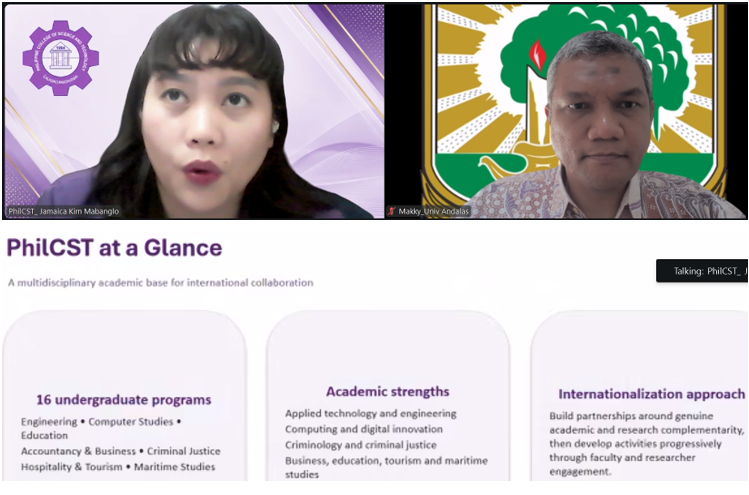
The initial meeting was held virtually via Zoom and brought together Mohammad
Maki from Universitas Andalas and Jamaica Kimabanglo, or Kim, Director of the
International Relations Office and Accreditation Officer at PhilCST. The
meeting aimed to formally introduce both institutions and identify potential
areas for concrete academic collaboration.
The meeting resulted in
an initial agreement to prioritize collaboration in computing and digital
innovation, as well as law and society/digital security. Both institutions also
identified an international webinar series as the most practical first activity
because it could immediately connect lecturers and researchers from both
universities without requiring physical mobility or complex logistical
arrangements. PhilCST will subsequently conduct internal consultations and
submit two to three priority areas for collaboration to UNAND.
Connecting Academic
Strengths in Indonesia and the Philippines
The discussion revealed
several complementary academic areas between the two institutions. PhilCST's
Computer Science and Information Technology programs can be linked with
Informatics and Information Technology at UNAND. Its Engineering programs can
be connected with UNAND's Electrical, Mechanical, Civil, Industrial, and
Environmental Engineering disciplines. Accountancy and Business can be linked
with Economics and Business, while PhilCST's Criminology program has potential
connections with Law and Social Sciences at UNAND.
One of the most
promising opportunities identified was interdisciplinary research in cybercrime
and digital security. Such collaboration could bring together PhilCST's Criminology
and Information Technology programs with UNAND's Law and Informatics
departments. This interdisciplinary approach is important because digital
security is not solely a technological issue but also involves law, crime
prevention, governance, and public protection.
Universitas Andalas also
introduced several collaboration schemes that may be developed once the
partnership enters the implementation stage, including credit-earning student
mobility, international summer courses, international conferences,
international team teaching, joint research, and an international Community
Engagement or Technology to Society program.
Through the Community
Engagement program, students, professors, and non-governmental organizations
from different countries could work directly with local communities in areas
such as disaster relief, livelihood improvement, health awareness, gender
equality, and economic skills development.
UNAND also introduced
opportunities for continuing education through the Fast Track Bachelor-to-Master
Program and the PMDSU Master-to-Doctoral Acceleration Program. The latter is
particularly relevant to PhilCST because the institution currently does not
offer a doctoral program.
International Webinar
Series as the First Step
As an initial implementation
activity, both institutions agreed that an international webinar series could
simultaneously serve as a researcher forum, researcher-matching platform, and
guest lecture program.
Potential topics
discussed include cybercrime, digital security, criminal justice, computing,
digital innovation, and cybersecurity. Each session is expected to feature one
speaker from Universitas Andalas and one speaker from PhilCST, allowing experts
from both institutions to interact directly and identify shared research interests.
The webinar is expected
to serve as more than a seminar. It could become an entry point for identifying
prospective joint researchers, international teaching partners, student
supervisors, and future coordinators of student mobility programs.
Universitas Andalas also
highlighted opportunities for PhilCST to participate in multinational research
consortia. UNAND has experience participating in international funding
proposals involving institutions from multiple countries, creating
opportunities for PhilCST to join future international grant consortia as a
partner from the Philippines.
Supporting SDGs 4, 9,
16, and 17
The proposed
UNAND–PhilCST collaboration has strong relevance to several United Nations
Sustainable Development Goals (SDGs).
The most direct
contribution is to SDG 4 – Quality Education. International webinars, team
teaching, student mobility, summer courses, Fast Track programs, PMDSU, and
possible credit recognition between institutions would broaden opportunities
for students and faculty members to gain international academic experience.
Collaboration in
computing, digital innovation, engineering, applied technology, and joint
research also supports SDG 9 – Industry, Innovation and Infrastructure. Joint
research may lead to new technologies, information systems, software, and
digital solutions that can potentially be utilized by communities, government
agencies, and industries.
The proposed focus on
cybercrime, digital security, criminal justice, and law and society has a
particularly strong connection to SDG 16 – Peace, Justice and Strong
Institutions. Research and educational collaboration in these fields can
strengthen institutional and societal capacity to address cybercrime, improve
information security, and develop legal and governance systems that are more
responsive to rapid technological change.
At the institutional
level, the entire UNAND–PhilCST partnership represents a direct contribution to
SDG 17 – Partnerships for the Goals, particularly through international
university networking, joint research, faculty and student exchange, and the
possible establishment of multinational research consortia.
If the Community
Engagement program is implemented in the future, the partnership could also
contribute to SDG 3 – Good Health and Well-being through health-awareness
initiatives, SDG 5 – Gender Equality through gender-related community programs,
SDG 8 – Decent Work and Economic Growth through economic skills and
entrepreneurship development, and SDG 11 – Sustainable Cities and Communities
through disaster resilience and community development activities.
Potential Social,
Economic, Environmental, and Community Impact
From a social
perspective, the collaboration has the potential to improve digital-security
literacy and awareness of cybercrime among students and wider communities.
Academic interaction between Indonesian and Philippine students and faculty
members may also strengthen intercultural understanding, professional networks,
and people-to-people relations within Southeast Asia.
From an economic
perspective, collaboration in digital technology, engineering, business, and
entrepreneurship may enhance students' employability and support the
development of applied research and innovations with commercial or economic
value. Joint research and multinational funding consortia could also attract
external research funding to both institutions.
The reciprocal-benefit
framework discussed during the meeting, including possible reciprocal tuition
waivers for student mobility, may further reduce financial barriers to
international academic experiences.
From a community
perspective, the Technology to Society program creates an opportunity to ensure
that international academic collaboration does not end with publications and
seminars. Research outcomes and academic expertise could instead be applied
directly to communities through livelihood development, health awareness,
gender equality, disaster preparedness, and economic capacity-building
programs.
Regarding the
environmental dimension, the meeting minutes do not yet provide evidence of
direct environmental impact because the partnership remains at the planning
stage. However, the inclusion of Environmental Engineering, applied technology,
sustainable engineering, and disaster-related activities creates opportunities
for future projects related to environmental sustainability and community
resilience.
Environmental indicators
should therefore be defined more specifically once joint projects have been
formally selected and implemented.
Contribution to the
Universitas Andalas Strategic Plan
The collaboration is
particularly relevant to Universitas Andalas' strategic objective of
strengthening its international academic environment.
International webinars,
international team teaching, student mobility, summer programs, researcher
matching, Fast Track and PMDSU pathways, as well as faculty-to-faculty
collaboration can all strengthen the internationalization of teaching,
learning, and research at UNAND.
The partnership also
contributes to the university's research and innovation agenda through
potential joint research in computing, digital innovation, cybersecurity,
engineering, applied technology, law, and social sciences.
The computing and
digital innovation component is also relevant to UNAND's digitalization agenda,
although at this early stage the partnership is better described as
strengthening digital capability and international academic collaboration
rather than directly delivering internal institutional digital transformation.
Similarly, its contribution
to student and institutional welfare remains indirect but could emerge through
tuition waivers, scholarship pathways, international exposure, competency
development, and greater access to global academic networks.
Accordingly, the
strongest strategic contributions of the UNAND–PhilCST initiative are expected
to be in internationalization of the academic environment, international
research networking, and innovation-oriented collaboration. Its contribution to
digitalization, graduate quality, international reputation, and societal impact
may become more measurable once specific programs are implemented.
Moving Toward
Implementation Within the Current Semester
As a follow-up, PhilCST
will consult its College of Criminal Justice Education and other relevant units
to determine two or three priority areas for collaboration. Universitas Andalas
will subsequently submit PhilCST's proposal for institutional review and
alignment.
Future meetings may also
involve Deans from Information Technology, Engineering, Economics and Business,
and other relevant academic units to discuss curriculum alignment and the
technical implementation of proposed activities.
Both institutions
expressed their intention to initiate at least one collaborative activity
within the current semester. Once the priority topics have been confirmed, both
parties will identify speakers for the inaugural webinar series as an initial
step toward broader cooperation in education, research, innovation, and
community engagement.
The UNAND–PhilCST partnership
is expected to become a gateway for stronger Indonesia–Philippines academic
cooperation, with the potential to generate benefits not only for universities
and researchers but also for students, industries, institutions, and
communities in both countries.