
Local Biodiversity, Global Research Ambition: EQUITY-Backed UNAND Study Accepted for Trends in Sciences
Padang, 09 October 2026
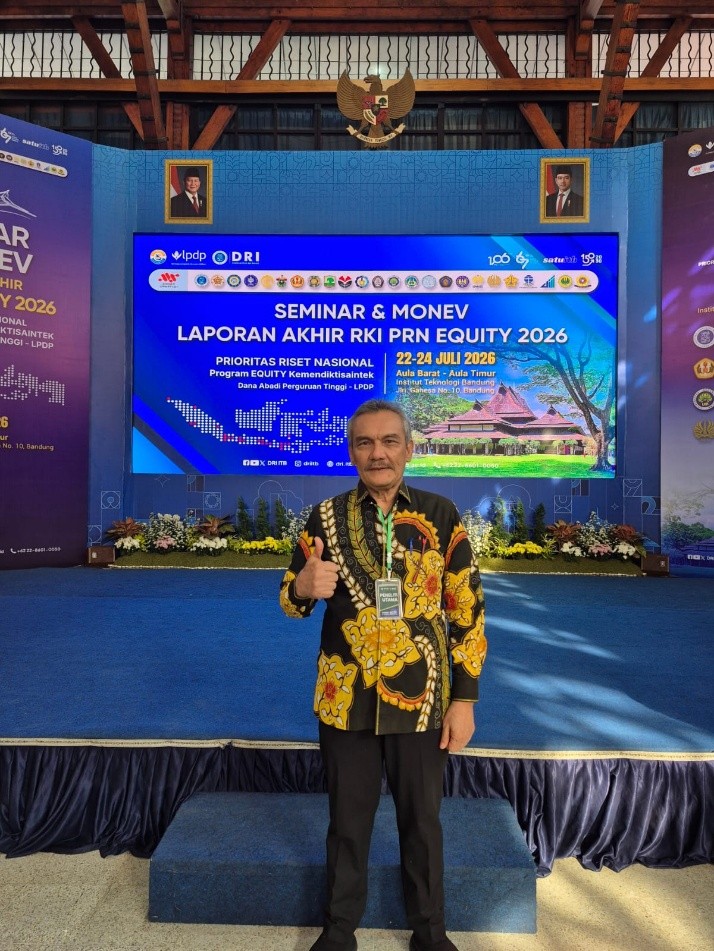
Prof. Fauzan Azima’s preclinical research shows how an interdisciplinary team can advance natural-product science—and encourages colleagues to turn early findings into well-defined research proposals.
PADANG — The EQUITY Program at Universitas Andalas
(UNAND) has supported a scientific manuscript accepted by the international
journal Trends in Sciences, with publication planned for its 2027 volume. For
lecturers considering the program’s next opportunity, the achievement offers a
concrete example of how local biological resources can be investigated through
rigorous, collaborative research.
The accepted manuscript is entitled “Cinnamomum
burmannii, Physalis angulata, and Eleutherine palmifolia Combination
Ameliorates Diabetic-Hypertensive Comorbidity in Rats.” The authors include
Prof. Fauzan Azima, Prof. Sri Rahayu Lestari, Dr. Addion Nizori, Dr. Desniarti,
Muhammad Iqbal, Sri Hartati, and Nia Devita Sari. Its status is acceptance for
future publication, not publication already completed.
The team investigated a combination of three
plants—Cinnamomum burmannii, Physalis angulata, and Eleutherine palmifolia—in a
rat model involving diabetes and hypertension. The work contributes to
preclinical evidence relevant to natural compounds and functional ingredients.
The findings cannot yet establish safety or effectiveness in humans; additional
mechanistic investigations and later-stage studies would be required before any
health application could be considered.
This distinction makes the research especially
instructive. A credible innovation pathway does not begin with a commercial
promise. It begins with a testable hypothesis, appropriate experimental methods,
careful interpretation, and clear decisions about what evidence must be
collected next.
Prof. Fauzan’s academic interests in food science,
functional ingredients, and natural products also show how research themes can
connect across disciplines. Food technology, pharmacy, medicine, biology,
chemistry, and other fields may each contribute to scientifically sound studies
of biodiversity and health-oriented innovation.
Vice Rector IV Prof. Henmaidi has highlighted the
value of internationally recognized research that responds to important
societal challenges. Here, the relevant challenge is complex metabolic health,
while the scientific opportunity lies in responsibly examining the potential of
plant-derived ingredients.
According to the direction articulated by EQUITY Chair
Dr. Eng. Muhammad Makky, S.T.P., M.Si., the program is intended to encourage
sustainable research outputs, stronger academic networks, and further research
development. The accepted manuscript is therefore not the end of the story; it
is a platform for asking better questions and designing the next research
stage.
For UNAND lecturers, the lesson is an invitation to
act. Researchers with promising preliminary data can begin preparing a focused
proposal, identify collaborators with complementary expertise, and articulate
feasible deliverables. Those working on local biological resources may find
especially valuable opportunities where scientific novelty meets a clearly
defined national or global problem.
Lecturers interested in future EQUITY calls are
encouraged to refine their research plans now and monitor official information
on eligibility, thematic priorities, funding provisions, submission
requirements, and deadlines. This achievement shows that careful research can
transform local scientific potential into an internationally relevant
contribution, one step at a time.
This activity is funded by the Indonesian Endowment Fund for Education
(LPDP) on behalf of the Indonesian Ministry of Higher Education, Science and
Technology and managed under the EQUITY Program (Contract
No.4304/B3/DT.03.08/2025).