
Gambir Innovation Reaches an International Journal: EQUITY Encourages UNAND Lecturers to Research Beyond Disciplinary Boundaries
Padang, 09 October 2026
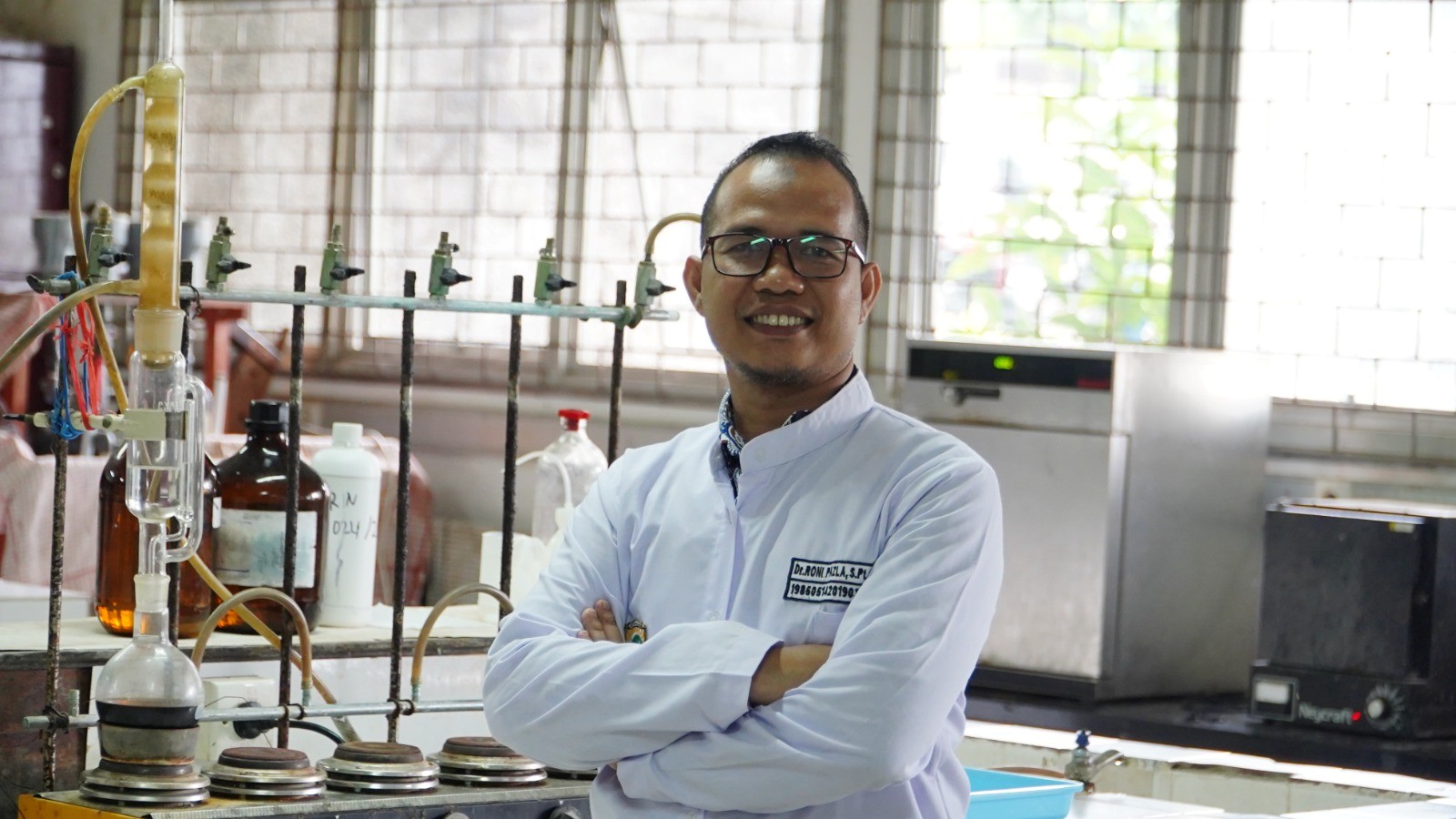
Dr. Roni Pazla’s study connects local gambir,
sustainable livestock production, and methane mitigation—demonstrating the opportunity
to develop research with scientific and regional significance.
PADANG
— Gambir, a commodity strongly associated with West Sumatra, is gaining
attention in a new area of scientific application: sustainable ruminant
nutrition. An EQUITY-supported study led by Dr. Ir. Roni Pazla, S.Pt., M.P., of
the Faculty of Animal Science, Universitas Andalas (UNAND), has resulted in a
scientific publication in the Czech Journal of Animal Science.
The
article, “Rumen-protected gambir catechins encapsulated using CaO-PFAD: Their
effects on rumen fermentation, nutrient digestibility, and methane production
in vitro,” investigates a functional feed approach using gambir catechins
encapsulated with calcium oxide and palm fatty acid distillate (CaO-PFAD). The
source material was obtained from Talang Maur, Lima Puluh Kota Regency, West
Sumatra.
Using
a randomized block design with four supplementation levels—0%, 5%, 10%, and
15%—and five replicates, the team tested effects under in vitro conditions. The
10% treatment yielded the most promising outcomes among the tested levels,
including higher propionate concentration, increased microbial protein
synthesis, improved nutrient digestibility, and lower methane production.
The
result is promising, but the distinction between laboratory and farm conditions
is essential. The findings do not yet demonstrate equivalent benefits in live
animals or commercial livestock systems. In vivo trials, formulation
development, practical performance assessment, and evaluation of economic feasibility
would be important next steps.
The
work addresses two challenges at once: improving utilization of feed nutrients
and investigating ways to reduce enteric methane emissions. It also identifies
an additional research-based application for a regional commodity. For UNAND,
the study illustrates how local resources can become starting points for new
scientific questions rather than remaining confined to their traditional
markets.
The
partnership dimension is equally important. The draft news identifies
collaboration involving UNAND, Hasanuddin University, Sultan Syarif Kasim State
Islamic University of Riau, the National Research and Innovation Agency, and
Prima Nusantara Bukittinggi University, among other research partners. Such
collaboration can bring together animal nutrition, biomaterials, process
engineering, and environmental science.
Vice
Rector IV Prof. Henmaidi has emphasized research that connects local potential
with issues of global importance. EQUITY Chair Dr. Eng. Muhammad Makky, S.T.P.,
M.Si., has similarly underscored the importance of extending research beyond
its initial output through further experiments, partnerships, and pathways
toward useful innovation.
For
lecturers across UNAND, this is an actionable example. An EQUITY research idea
might begin with a local commodity, a measurable technical bottleneck, and an
interdisciplinary team capable of investigating a solution. Well-designed
proposals should distinguish what is already proven from what remains to be
tested, while identifying a realistic path toward publications, partnerships,
or later-stage application.
As
future EQUITY opportunities are announced, lecturers are invited to develop
collaborative proposals and consult official guidance on themes, eligibility,
selection criteria, and submission dates. Dr. Roni’s research demonstrates that
meaningful work can emerge when regional strengths are connected to
internationally relevant scientific challenges.
This activity is funded by the Indonesian Endowment Fund for Education
(LPDP) on behalf of the Indonesian Ministry of Higher Education, Science and
Technology and managed under the EQUITY Program (Contract
No.4304/B3/DT.03.08/2025).