
EQUITY-Funded UNAND Research on Green Nanohybrids Accepted in Q1 Elsevier Journal Ceramics International
Padang, 09 October 2026
PADANG
— A research manuscript funded by the EQUITY Program of Universitas Andalas has
been accepted for publication in Ceramics International, a Q1 international
journal published by Elsevier. The accepted manuscript is entitled “Green
Synthesis of Yttria/ZnO/Ag2O (YZA) Ternary Nanohybrids with Enhanced
Structural, Optical, and Biomedical Properties.”
The
acceptance of the manuscript in a Q1 Elsevier journal marks an important
academic achievement for Universitas Andalas, particularly in strengthening
international research visibility in the field of advanced materials, green
synthesis, and biomedical-oriented nanotechnology.
The
acceptance letter, dated October 9, 2026, confirmed that the manuscript has
been accepted for publication and will proceed to the production stage for
proof preparation. The reviewer also noted that the revised manuscript had been
carefully reviewed and that the author had satisfactorily addressed earlier
comments.
The
study focuses on the green synthesis of Yttria/ZnO/Ag2O, or YZA, ternary
nanohybrids. Based on its title, the work contributes to the development of
nanomaterials with enhanced structural, optical, and biomedical properties.
This type of research is important because nanomaterials can offer new
possibilities for advanced materials, health-related applications, and
environmentally conscious synthesis approaches.
The
funding support from EQUITY Universitas Andalas is significant because it
enables researchers to strengthen laboratory-based research, develop
internationally visible scientific outputs, and build a clearer pathway for
further research development. In this case, EQUITY support contributes to a
manuscript that has reached acceptance in a Q1 Elsevier journal and may open
opportunities for broader collaboration in green nanomaterials and biomedical
materials research.
The
phrase “green synthesis” is particularly significant. It indicates that the
study is positioned within a more sustainable research pathway, where the
development of advanced materials is not only assessed for performance, but
also considered in relation to safer, more efficient, and potentially more
environmentally responsible preparation methods.
At
the same time, the biomedical dimension of the study should be interpreted
carefully. The acceptance of this manuscript strengthens the scientific
foundation for further investigation, but biomedical relevance requires
responsible follow-up research, including deeper mechanism studies, safety
evaluation, reproducibility assessment, and later-stage validation before
broader applications can be considered.
This
distinction makes the research especially important for the development of
credible innovation. Strong research does not begin with direct application
claims. It begins with well-defined synthesis, careful characterization,
appropriate testing, and a clear understanding of what evidence is still needed
for the next stage.
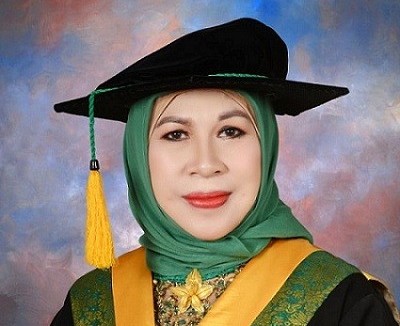
Prof.
Yetria Rilda’s work demonstrates how materials science can connect with
chemistry, nanotechnology, health-oriented research, and sustainable
innovation. The accepted manuscript also shows that EQUITY-funded research at
UNAND continues to contribute to scientific fields that are increasingly
relevant to global research priorities, particularly in advanced materials,
green technology, and biomedical innovation.
Vice
Rector IV Prof. Henmaidi has emphasized that internationally recognized
research is important for strengthening UNAND’s academic visibility and global
contribution. In this context, the accepted manuscript reflects how research at
Universitas Andalas can engage with advanced scientific questions while
maintaining relevance to sustainability, innovation, and future applications.
Chair
of EQUITY Universitas Andalas, Dr. Eng. Muhammad Makky, S.T.P., M.Si., stated
that the acceptance of this manuscript reflects the role of EQUITY in
supporting research that is internationally visible, scientifically rigorous,
and oriented toward sustainable development.
“This
achievement shows that EQUITY funding can help UNAND researchers strengthen
their research pathway from laboratory work to international publication.
Acceptance in a Q1 Elsevier journal is an important recognition, but for
EQUITY, publication acceptance is not the final destination; it is a starting
point for building stronger collaboration, developing the next research stage,
and expanding academic impact,” said Muhammad Makky.
He
added that green nanomaterials research is highly relevant because it sits at
the intersection of science, technology, sustainability, and potential
health-related innovation.
“Research
on green synthesis and biomedical materials needs to be developed carefully and
responsibly. EQUITY encourages researchers to build strong evidence step by
step through rigorous methods, international publication, follow-up studies,
and future collaboration. This is how scientific ideas can grow into a
sustainable research agenda,” he added.
The
study is also relevant to several Sustainable Development Goals. Its biomedical
orientation connects with SDG 3: Good Health and Well-being. Its contribution
to advanced materials and nanotechnology aligns with SDG 9: Industry,
Innovation and Infrastructure. The green synthesis aspect relates to SDG 12:
Responsible Consumption and Production. The potential environmental relevance
of sustainable synthesis also supports SDG 13: Climate Action.
For
UNAND lecturers and researchers, this EQUITY-funded achievement offers an
important lesson. A strong research contribution can emerge from a focused
scientific question, solid experimental design, and careful positioning within
global research needs. Researchers working in chemistry, materials science,
biotechnology, pharmacy, engineering, and health-related fields can identify
opportunities where advanced laboratory research meets sustainability and
biomedical relevance.
Lecturers
preparing future research proposals are encouraged to refine their research
questions, strengthen laboratory-based evidence, and identify collaborators
with complementary expertise. A manuscript acceptance such as this shows that
carefully developed research, supported by EQUITY Universitas Andalas, can
contribute to international academic visibility while opening new directions
for interdisciplinary and application-oriented studies.
Moving
forward, the accepted manuscript is expected to support further research on
green nanomaterials, biomedical applications, and sustainable synthesis
approaches. More importantly, it demonstrates that UNAND’s research ecosystem
can continue to grow through EQUITY-funded research, rigorous science,
international publication, and responsible innovation development.
This
activity is funded by the Indonesian Endowment Fund for Education (LPDP) on
behalf of the Indonesian Ministry of Higher Education, Science and Technology
and managed under the EQUITY Program (Contract No.4304/B3/DT.03.08/2025).