

Universitas Andalas Students Develop Laundry Wastewater Filtration Technology to Support SDG 6 and SDG 12
Padang, 08 December 2022
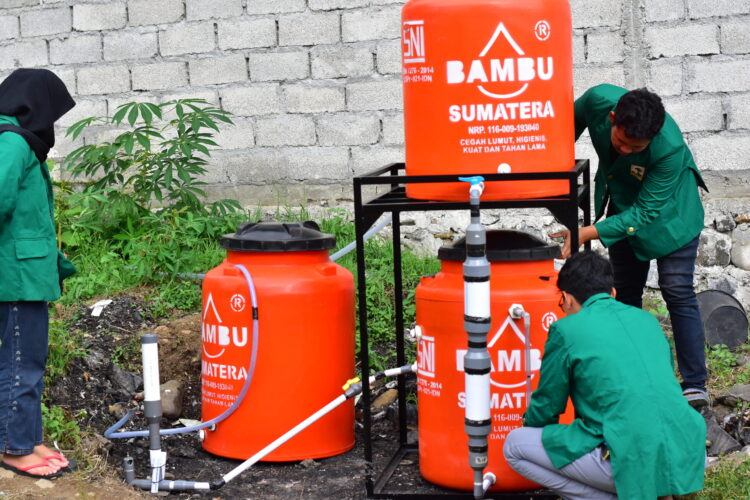
A team of students from
Universitas Andalas has developed a laundry wastewater filtration device using
upflow anaerobic technology to help reduce water waste and environmental
pollution from laundry businesses. This innovation is closely linked to SDG 6
on Clean Water and Sanitation and SDG 12 on Responsible Consumption and
Production, as it promotes cleaner water management while encouraging more
efficient and sustainable use of resources.
The innovation was created by
the PKM-PI team from the Department of Mechanical Engineering at Universitas
Andalas, consisting of Rezza Fiqrathul Putra, Muhammad Rizqi, Nurul Qolbi,
Muhammad Fathurrahman, and Faizal Hakiki. The project received funding support
from Belmawa through a science and technology proposal under the supervision of
Dr. Eng. Dendi Adi Saputra. According to the team, the technology was designed
as a practical solution for a laundry MSME in Kapalo Koto, Pauh District,
Padang City, namely Halona Laundry, which had been facing high water
consumption and wastewater disposal problems.
Before the technology was
introduced, the laundry business reportedly used a large volume of water, which
increased operational costs, while detergent wastewater discharged directly
into drains created pollution and unpleasant odors for nearby residents. In
response to these problems, the student team designed a filtration device that
operates without electricity and applies upflow anaerobic technology to process
detergent-containing wastewater into cleaner water that can be reused.
The system works by channeling
laundry wastewater into an anaerobic tank, where sedimentation takes place. The
water is then processed through two stages of filtration containing layers of
ijuk fiber, sand, zeolite stones, activated charcoal, and carbon fiber. After
passing through the filtration stages, the treated water is pumped into a
special clean-water tank using a hydraulic ram pump, which does not require
electrical power. The team explained that the resulting water can then be
reused for laundry washing activities.
According to the reports, the
filtered water was tested at the Water Laboratory of the Department of
Environmental Engineering at Universitas Andalas. The results showed that the
water was safe to reuse and also safe to discharge into the environment without
causing water pollution. The student team also stated that, beyond addressing wastewater
problems, the device can reduce water bills by up to 60 percent, offering both
environmental and economic benefits for laundry businesses.
The owner of Halona Laundry,
Alex, gave a positive response to the innovation, saying that the technology is
environmentally friendly and does not require electricity in its operation.
Meanwhile, Dr. Eng. Dendi Adi Saputra expressed hope that the device would
truly help the partner business reduce operating costs, improve water-use
efficiency, and overcome pollution caused by detergent wastewater. The team
also noted that the technology still requires further refinement, including
testing the durability and replacement cycle of the filters, and expressed hope
that it could eventually be commercialized and adopted more widely by laundry
businesses and the public.