
Universitas Andalas Strengthens Net Zero Emission Pathway through DEN–PSLH Forum, Supporting SDG 7 and SDG 13
Padang, 06 November 2024
Padang, November 6, 2024 — Universitas Andalas
continues to strengthen its role in supporting sustainable energy transition
and climate action in line with SDG 7 (Affordable and Clean Energy) and SDG 13
(Climate Action). Through a public lecture organized by the Center for
Environmental Studies (PSLH), the university facilitated the dissemination of
national energy balance analysis to enhance understanding among academics and
students regarding energy management challenges and the urgency of
transitioning to sustainable energy systems.
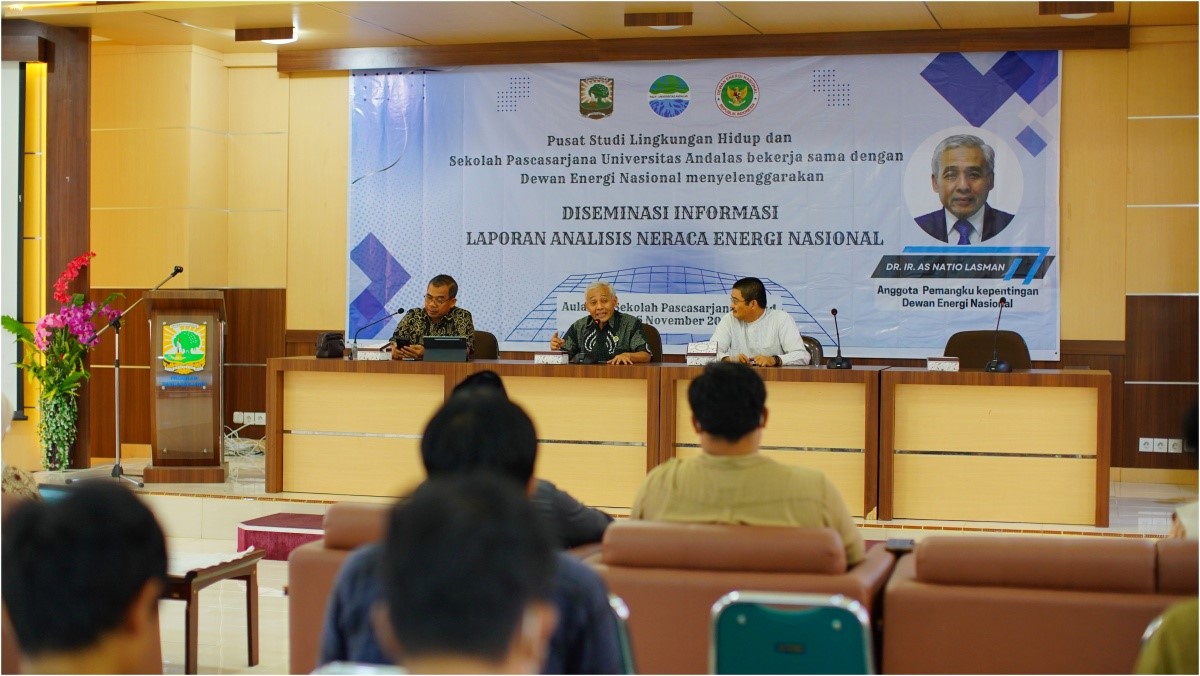
The public lecture, titled Dissemination of
National Energy Balance Analysis, was held at the 3rd floor of the Graduate
School Building, Universitas Andalas. The event featured Dr. Ir. As Natio
Lasman, a stakeholder member of the National Energy Council (DEN), and was attended
by lecturers as well as undergraduate and postgraduate students.
In his presentation, Dr. As Natio Lasman explained
that Indonesia’s current energy landscape is still heavily dominated by fossil
fuels such as oil, gas, and coal. This dependency presents significant
challenges due to the finite nature of fossil resources and the substantial
government subsidies required to sustain them. He also highlighted global
geopolitical dynamics as a factor that may disrupt national energy supply
chains.
“International geopolitical conditions, such as
conflicts, can indirectly affect and disrupt the energy supply routes that
Indonesia depends on,” he stated.
He further emphasized that fossil fuel consumption
contributes to greenhouse gas (GHG) emissions, which drive global warming.
Therefore, emission control remains a critical agenda in national energy
management. “If GHG emissions are not controlled, global temperatures will
continue to rise,” he added.
Indonesia, he noted, is targeting Net Zero Emission
by 2060, aiming to balance emitted and absorbed carbon through comprehensive
national energy policies. “By 2060, Indonesia is projected to reach a balance
where emissions produced are equal to those absorbed,” he explained.
Additionally, he highlighted the significant
potential for renewable energy development in Indonesia, particularly
geothermal energy. One promising area is South Solok in West Sumatra, which
possesses substantial geothermal resources suitable for sustainable energy
development.
Meanwhile, Head of the Center for Environmental
Studies, Universitas Andalas, Mahdi, S.P., M.Si., Ph.D., emphasized that energy
demand continues to grow alongside economic development and population
increase. Nearly all human activities, from electricity use to transportation,
depend heavily on energy availability.
According to him, this condition requires solutions
that not only meet energy demands but also ensure environmental sustainability.
“This calls for solutions that not only focus on fulfilling energy needs but
also safeguard environmental sustainability for a better future,” he concluded.
Through this initiative, Universitas Andalas
reinforces its academic role in enhancing energy literacy and encouraging
higher education institutions to contribute actively to sustainable energy
development and climate change mitigation.