
Universitas Andalas Restores Post-Disaster Access to Clean Water in West Sumatra with Electricity-Free Technology in Support of SDG 6 and SDG 9
Padang, 29 December 2025
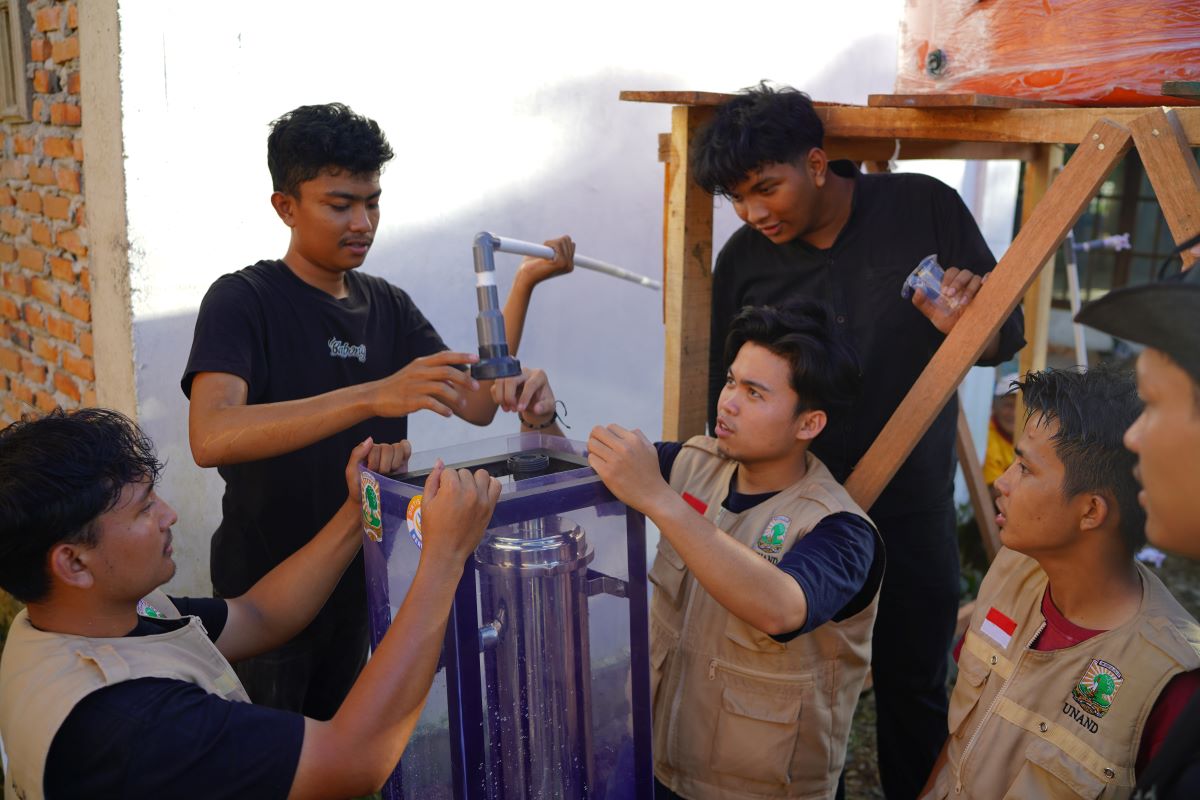
Universitas Andalas has taken
action to restore access to clean water in disaster-affected areas of West
Sumatra by installing water purification systems at more than 10 locations.
This initiative is aligned with SDG 6 on Clean Water and Sanitation and SDG 9
on Industry, Innovation and Infrastructure, as it provides a technical solution
that directly addresses basic community needs while applying appropriate
technology in emergency situations.
The effort was carried out
through the Disaster Response Community Service Program funded by the Ministry
of Higher Education, Science, and Technology. The Universitas Andalas Clean
Water Team, led by Dr. Eng. Ir. Dendi Adi Saputra, deployed to Padang Pariaman
Regency, Solok Regency, and Padang City to assist communities facing a clean water
crisis in the aftermath of disaster. The team’s presence brought not only
assistance, but also concrete solutions in the form of water purification
system installations at locations that had become centers of activity for
residents and displaced people.
Before the installations were
carried out, the team first conducted surveys and water quality testing based
on information provided by local residents. The survey results showed that
after the floods, water flow in several locations was frequently disrupted and
the available water was in a turbid condition. To address this situation, the
team applied ultrafiltration technology capable of operating without electrical
power, making it particularly suitable for disaster areas where infrastructure
had not yet been fully restored.
Based on initial test results,
the turbidity level of water in the affected areas reached 185 NTU, far above
health standards. After undergoing filtration through the ultrafiltration
system, water quality improved dramatically to 0.9 NTU, which was considered
very good and even met drinking water standards. In addition to installing
filters with a capacity of 20,000 liters per hour, the team, which also
involved Mechanical Engineering students, repaired damaged pipelines, water
pumps, and storage tanks at several locations.
The clean water systems have
been installed at various strategic points, including Al-Kautsar Mosque in
Nagari Muaro Pingai, the Muaro Pingai Walinagari Office, the Agriculture
Office, SMP Negeri 2 Junjung Sirih, Jorong Subarang in Nagari Paningahan, Surau
Tuo in Nagari Saniang Baka, Nagari Salibutan, Mushalla Katimaha in Nagari Pasia
Laweh, Surau Gadang, Surau Janjang, Ubudiyah Mosque in Nagari Palembayan, and
Nurul Ilmi Mosque in Limau Manis, Padang City. This distribution shows that the
recovery efforts were directed toward locations that are accessible and can be
directly utilized by the wider community.
The presence of these clean
water facilities was welcomed positively by affected residents. One evacuee at
Mushalla Katimaha in Padang Pariaman stated that previously the displaced
residents had relied on only one spring well for many people. With clean water
once again available, the toilet and bathroom facilities at the mushalla can
now be used more properly and separately by women and men. The restoration of
clean water access demonstrates that universities can play a direct role during
emergency response periods, not only through academic expertise, but also
through tangible actions that make a real difference in people’s lives.