
Universitas Andalas’ PKM-TKM Team Promotes Composite Corn Seed Innovation and Organic Fertilizer Processing in Support of SDG 2 and SDG 12
Padang, 29 July 2025
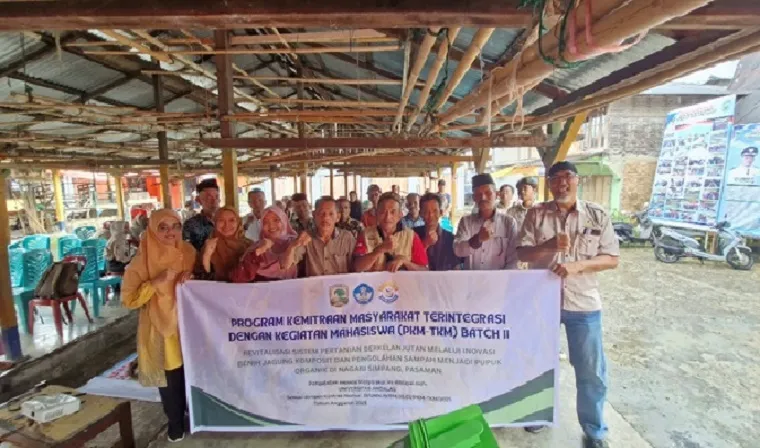
The PKM-TKM community service team from the
Faculty of Agriculture at Universitas Andalas conducted an outreach visit to
Nagari Simpang, Pasaman, on Saturday, July 26, 2025, to introduce sustainable
farming practices through composite corn seed innovation and household waste
processing into organic fertilizer. The initiative is most closely linked to
SDG 2 on Zero Hunger and SDG 12 on Responsible Consumption and Production, as
it combines efforts to strengthen food production with more sustainable waste management
practices.
The program was led by Fitri Ekawati, a lecturer
from the Department of Agronomy at the Faculty of Agriculture, Universitas
Andalas, who also served as the field supervisor for 20 students carrying out
their community service program in the nagari from July 7 to August 18. The
activity also involved three other lecturers: Prof. Ir. Irfan Suliansyah from
the Department of Agronomy, Siti Nurhasanah from the Department of Public
Health, and Yulistriani from the Department of Agribusiness. The event drew
nearly 80 participants, including farmers, community leaders, village
officials, Universitas Andalas KKN students, and KKN students from UIN Imam
Bonjol Padang.
According to the organizers, the program was
designed as a shared effort to help create a more prosperous Nagari Simpang,
where most residents work in agriculture. The team emphasized that this goal
could be pursued through the use of superior composite corn seeds and through
better management of household waste, which has not yet been properly handled
and can instead be processed into organic fertilizer. The activity was also
intended to serve as a means of transferring practical knowledge and skills to
the community in order to improve agricultural productivity while raising
awareness of environmental management and health.
The outreach responded directly to two major
local challenges identified in the nagari: waste disposal and the difficulty
faced by corn farmers in obtaining hybrid corn seed, which residents described
as both expensive and hard to access. The village head, Jumailis, welcomed the
program and said the nagari remained open to knowledge transfer from academics
to help build a more independent and prosperous community. He noted that waste
remains a persistent issue, with some residents still disposing of household
waste into rivers despite village efforts to provide free waste collection
twice a week.
During the session, Prof. Irfan Suliansyah
delivered material on composite corn and organic fertilizer as pathways toward
food self-reliance and ecological balance. He explained that while composite
corn may not yield as highly as hybrid corn, it is more adaptable to
environmental conditions and allows farmers to reuse seeds from previous
harvests for the next planting season. He also noted that hybrid corn generally
requires high agricultural inputs, particularly inorganic fertilizers, and that
excessive long-term use of such fertilizers can damage soil structure and
texture. As a result, he encouraged a gradual transition toward organic
fertilizer, including fertilizer made from household waste, to improve the
physical, chemical, and biological quality of the soil.
Public health lecturer Siti Nurhasanah addressed
the health risks associated with throwing waste into rivers, warning that the
practice can contribute to water pollution and trigger diseases such as
diarrhea, typhoid, cholera, dengue fever, dysentery, and skin disorders. She
encouraged residents to separate organic and inorganic waste, process organic
waste into fertilizer, and adopt the 3R approach of reducing, reusing, and
recycling. She also highlighted the importance of cross-sector collaboration
involving citizen cooperatives, the environmental office, and the health office
for disease surveillance and sanitation education.
From the agribusiness perspective, Yulistriani
discussed ways to increase farmers’ added value by optimizing supply chains and
expanding market access. She said many farmers still sell their harvests to
middlemen at low prices, leaving them with only minimal profits. To address
this, she proposed shortening the supply chain through cooperative formation,
product processing, marketplace technology, partnerships with industry, and
collective logistics. She also encouraged wider market access through
agribusiness e-commerce, product certification, halal labeling, better
packaging, and stronger product branding.
The activity concluded with a practical
demonstration by Universitas Andalas KKN students on how to process waste into
organic fertilizer using compost bags. The community service team also handed
over several innovation tools and materials, including an electric corn
shelling machine, composite corn seeds, and compost bags. Overall, the program
presented a community-based model that linked sustainable agriculture, waste
utilization, and farmer empowerment in a single effort to strengthen local
resilience.