
Universitas Andalas KKN Students Create Economic Opportunities through Songket Waste Recycling in Silungkang Tigo, Supporting SDG 12 and SDG 8
Padang, 08 August 2025
Sawahlunto, August 8, 2025 —
Universitas Andalas continues to support sustainable development through
community-based innovation in line with SDG 12 (Responsible Consumption and
Production) and SDG 8 (Decent Work and Economic Growth). Students participating
in the Community Service Program (KKN) introduced an initiative to transform
woven songket fabric waste into economically valuable products in Silungkang
Tigo Village, Sawahlunto.
Silungkang Tigo is widely
recognized as a center for high-quality songket weaving with distinctive
traditional motifs. However, the production process generates textile waste in
the form of fabric scraps and leftover threads, which are often discarded or
burned. In response to this issue, Universitas Andalas students conducted field
observations at a weaving facility in the Jembatan Merah area, Silungkang Oso,
before developing a solution to convert waste into marketable handicrafts.
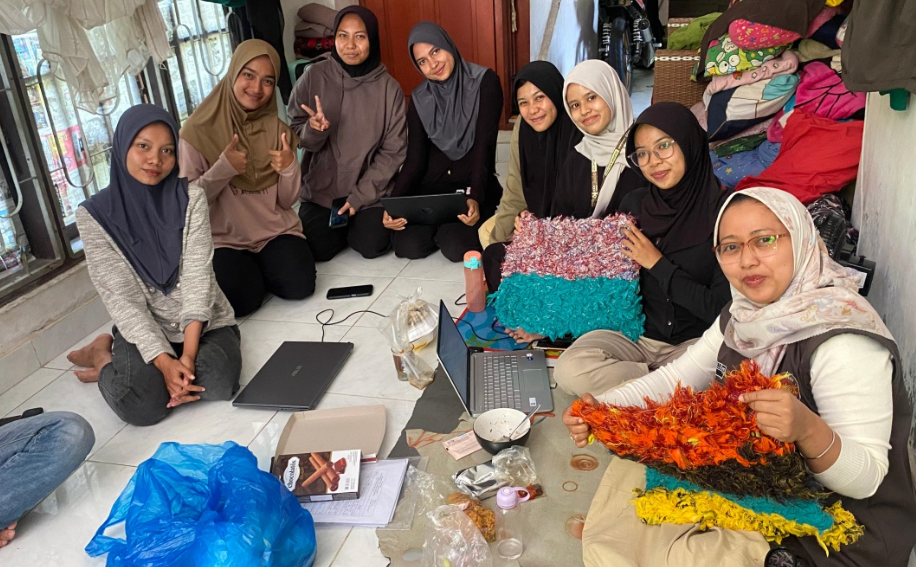
Fauzan, the program coordinator,
explained that doormats were selected as the primary product due to their
simple production process, low capital requirements, and strong market demand.
The production involves weaving approximately 3.5 meters of fabric edge waste
combined with plastic rope, using simple tools made of wood and metal. Each
doormat can be completed in approximately 20 minutes.
The finished products are
marketed at prices ranging from IDR 20,000 to IDR 25,000 per unit, both online
through platforms such as Shopee, Lazada, and Facebook, as well as offline in
traditional markets. This initiative also revitalizes a similar program previously
introduced by the Head of Silungkang Tigo Hamlet, Ferinof, which had not yet
gained optimal community participation.
The program is part of the
Universitas Andalas KKN activities supported by the Integrated Community
Partnership Program (PKM-TKM) grant scheme and supervised by Field Supervisor
Revi Marta, M.I.Kom. In addition to reducing environmental waste, the
initiative is expected to increase community income and create new business
opportunities in the village.
Looking ahead, the utilization
of weaving waste has the potential to expand beyond doormats into a variety of
creative products, including bags, wallets, tablecloths, and decorative
cushions. This innovation is expected to strengthen Silungkang Tigo’s identity
not only as a weaving center but also as a hub for sustainable, waste-based
creative industries.