

Universitas Andalas KKN Students Advance Digital Village Economy in Nagari Pasar Tapan in Support of SDG 8 and SDG 9
Padang, 09 July 2025
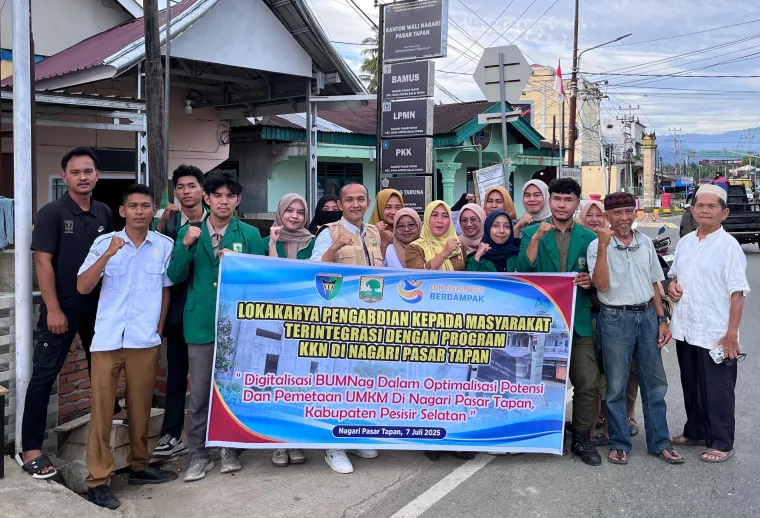
Universitas Andalas students
participating in the KKN program have launched a community engagement
initiative in Nagari Pasar Tapan, Basa Ampek Balai Tapan District, Pesisir
Selatan, through a workshop focused on strengthening village-owned enterprises
and local MSMEs through digitalization. The initiative is closely linked to SDG
8 on Decent Work and Economic Growth and SDG 9 on Industry, Innovation and
Infrastructure, as it seeks to expand local economic opportunities through
digital systems, entrepreneurship support, and stronger village-level economic
governance.
The workshop, titled
“Digitalization of BUMNag in Mapping Local Potential and Empowering MSMEs in
Nagari Pasar Tapan,” became a forum for dialogue and coordination among
students, the nagari government, BUMNag management, youth groups, and MSME
actors. Those present included the acting wali nagari of Pasar Tapan, the nagari
secretary, the head of Karang Taruna, the director of BUMNag, and Universitas
Andalas field supervisor Ilham Havifi, M.I.Kom. The activity reflected a
collaborative effort to ensure that community service programs respond directly
to local needs and development priorities.
Ilham Havifi explained that KKN
is not only part of the Kampus Berdampak program promoted by the Ministry of
Education, Culture, Research, and Technology, but also a concrete form of
student contribution to development based on local potential. He noted that the
program is designed to allow students to learn directly in the community
outside campus, with the outcomes recognized as four academic credits within
the KKN course. He also emphasized that Nagari Pasar Tapan has strong potential
as a center of trade and MSME growth, but still lacks an adequate digital
system to support the management of local economic information.
To address this gap, a team of
17 Universitas Andalas students from different study programs designed a work
plan built around three main pillars: systematic MSME data collection, the
development of an MSME e-catalog repository website, and digital literacy
training for local officials and business actors. The digital system was
designed by adapting the model of the Integrated Business Service Center,
allowing the public to access information about local MSMEs, featured products,
ordering contacts, and business locations through a single online platform.
The MSME mapping process was
carried out using spreadsheet-based data for each business unit, including
business name, type of product, production capacity, and location. The data
were then processed by BUMNag together with the students into a village MSME
service website, which is planned to be linked directly to the official website
of the Nagari Pasar Tapan Government under the Pesisir Selatan Regency
administration. Through this platform, the promotion and marketing of local
products are expected to become broader, more efficient, and more accountable.
In addition to building the
digital system, the students also facilitated training on digital content
management, product branding, and the use of social media as a business
promotion tool. This effort was intended to improve the digital literacy of
MSME actors, who have so far had limited ability to use information technology
to expand their market reach and competitiveness. The acting wali nagari of
Pasar Tapan stated that the initiative matched the nagari’s need to build a
digital database of local potential and strengthen the community’s economic
ecosystem, while expressing hope that the system would be used not only for
data collection but also as a lasting promotional and business information tool
for residents.
Overall, the program
demonstrates how Universitas Andalas students are contributing not only
academic knowledge, but also practical technology and systems that can support
sustainable local development. With support from the community and the nagari
government, the initiative is expected to become a replicable model for the
digitalization of village economies in other areas, while leaving behind
knowledge and technology that remain useful beyond the KKN period.