
UNAND Supports SDG 4 and SDG 10 through Inclusive UTBK Services for Participants with Disabilities
Padang, 21 April 2026
Padang, April 21, 2026 — Universitas Andalas (UNAND) reaffirmed its commitment to
inclusive education by facilitating 11 participants with disabilities during
the Computer-Based Written Examination, known as UTBK, on Tuesday, April 21.
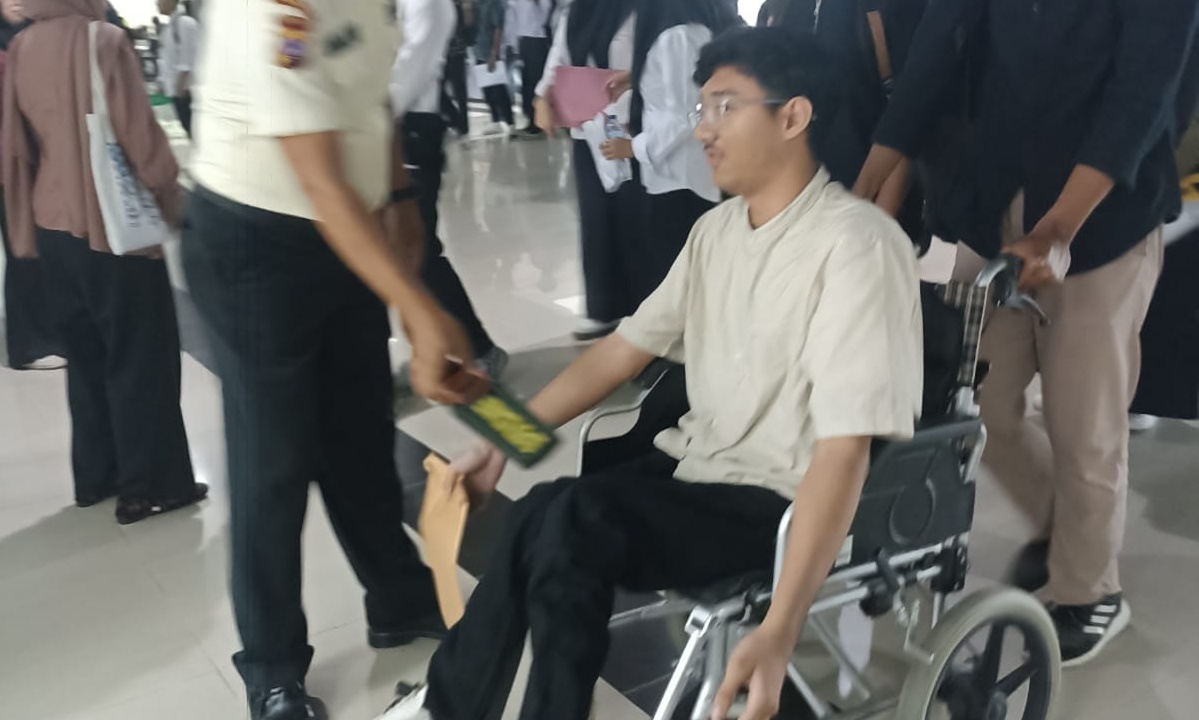
One of the participants, Reshma
Adiva, a candidate with physical disability, took the examination at the UNAND
Library Building after the university adjusted her test location to support
accessibility. She was initially scheduled to take the exam on the third floor
of the Faculty of Engineering Building. However, after confirming her condition
with the UTBK committee at UNAND, the university quickly moved her examination
room to the ground floor of the Library Building on the same day, making it
easier for her mobility.
For Reshma, taking UTBK was not only
about completing an entrance examination, but also part of her effort to pursue
her dream of continuing her education at university level and developing her
potential in the future. She expressed appreciation for the university’s quick
response in providing a more accessible examination location.
In the 2026 UTBK implementation at
UNAND, a total of 11 participants with disabilities took part in the
examination. The participants consisted of candidates with physical
disabilities and hearing impairments. They were specially scheduled to take the
examination on the first day in the Directorate of Information Technology room
to ensure more optimal and coordinated services.
UNAND’s decision to adjust
facilities and provide specific arrangements reflects the university’s
commitment to ensuring equal opportunities for all prospective students. The
inclusive service was designed so that participants with special needs could
take the selection process comfortably, while maintaining the quality and
integrity of the UTBK implementation.
Director of Education and Learning
at UNAND, Dr. Mahdhivan Syafwan, emphasized that inclusivity is a key concern
in every stage of new student admission. He explained that UNAND provided
special arrangements both in terms of location and technical support, allowing
participants with disabilities to take the examination in a more supportive
environment.
According to Dr. Mahdhivan, adaptive
services are part of UNAND’s broader commitment to ensuring equal access to
education for all prospective students. He stressed that the university wants
to become a friendly and open space for everyone.
This initiative supports SDG 4
Quality Education by promoting inclusive and equitable access to higher
education. Through accessible examination facilities and technical support,
UNAND helps ensure that prospective students with disabilities can participate
in the university admission process fairly and comfortably.
The program also aligns with SDG
10 Reduced Inequalities because it reduces barriers faced by participants
with disabilities in accessing educational opportunities. By providing adaptive
services and reasonable accommodation, UNAND strengthens its role in creating a
more inclusive campus environment.
Through this inclusive UTBK service,
UNAND demonstrated that access to higher education must be open to all. The
university’s quick response and coordinated support for participants with
disabilities reflect its commitment to building a campus that values equality,
accessibility, and the potential of every prospective student.