
UNAND Supports SDG 2 and SDG 12 through Climate-Smart Agricultural Waste Innovation
Padang, 30 July 2025
Padang,
July 30, 2025 — Universitas Andalas (UNAND)
continues to strengthen its role in supporting sustainable development through
an educational community service program focused on improving crop
microclimates by optimizing the use of agricultural waste.
The
program is part of UNAND’s 2025 Community Service Scheme under the Program
Kemitraan Masyarakat Membantu Usaha Berkembang. Funded by UNAND, the
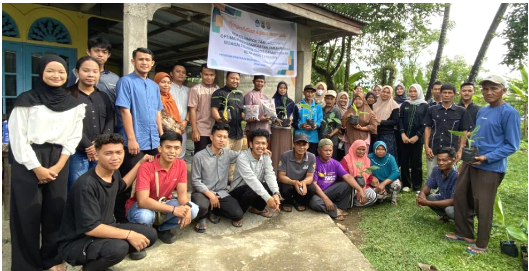
activity is led by Nugraha Ramadhan, a lecturer at the Faculty of Agriculture,
with the Taruko Saiyo Farmer Group in Pauh District, Padang City, as the
partner community.
This
initiative was developed to address several challenges faced by farmers,
including limited agricultural waste processing practices, declining soil
fertility, and low levels of technological literacy and skills among farming
communities. Through this program, UNAND introduced four integrated activities:
processing agricultural waste into compost, constructing biopore infiltration
holes, producing biochar from rice husks, and applying agricultural waste such as
straw as mulch.
In
the composting activity, farmers were encouraged to utilize various types of
agricultural waste, including straw, livestock manure, coconut fiber,
unproductive banana stems, and fruits no longer suitable for consumption. These
materials are processed into organic compost that can help improve soil
fertility while reducing the accumulation of unused organic waste in the
environment.
The
program also introduced biopore infiltration holes as an appropriate technology
to improve water absorption and land drainage. This method helps rainwater
infiltrate the soil more effectively, reducing the risk of erosion and
waterlogging while gradually improving the structure and quality of
agricultural land.
In
addition, rice husk waste was processed into biochar through pyrolysis, a
burning process carried out without air or with limited air. The resulting
carbon-rich material can improve the soil’s capacity to retain water and
nutrients, supporting more productive and sustainable farmland management.
Another
solution introduced through the program was the use of straw as mulch for
cultivated plants. Instead of being left to decay or burned, straw can be used
to suppress weed growth, maintain soil moisture, reduce water evaporation, and
add organic matter to the soil as it decomposes.
According
to Nugraha Ramadhan, the main objective of the program is to increase farmers’
understanding, skills, and participation in agricultural waste management and
the application of appropriate technology. The program is expected to create a
more optimal microclimate for cultivated plants while also contributing to
long-term productivity and environmental resilience.
This
community service initiative reflects UNAND’s commitment to supporting SDG
2: Zero Hunger by promoting sustainable agriculture, improving soil
fertility, and strengthening crop-growing conditions for farmers. At the same
time, the program contributes to SDG 12: Responsible Consumption and
Production by transforming agricultural waste into useful resources such as
compost, biochar, and mulch.
Through
this collaboration, UNAND continues to support sustainable development and
farmer welfare in West Sumatra through climate-smart agriculture. The program
is also expected to become an adaptable model that can be implemented more
widely to support sustainable agriculture across Indonesia.