

UNAND Student Innovation Supports SDG 6 and SDG 12 through Electricity-Free Water Filtration Technology
Padang, 06 September 2022
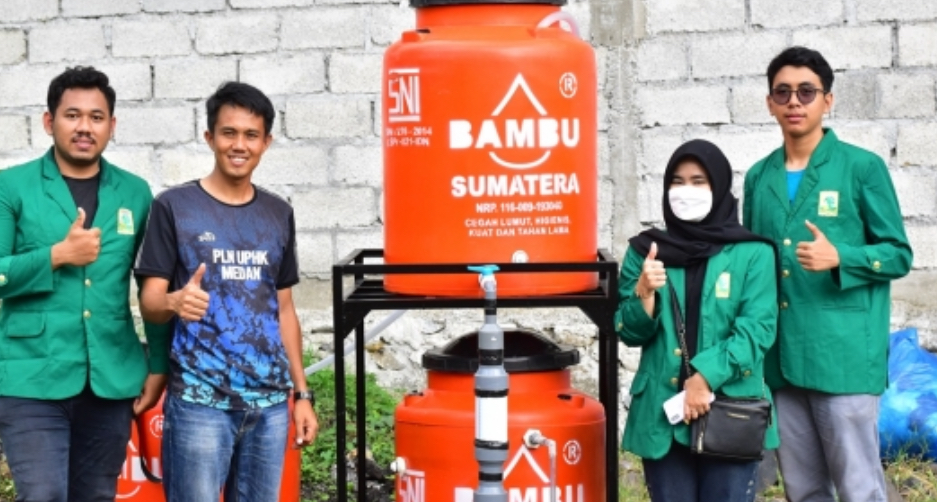
Padang, September 6, 2022 — Universitas Andalas (UNAND) students have developed an
electricity-free water filtration device to help address water waste and
environmental pollution caused by detergent wastewater from laundry businesses.
The innovation was created by a team
from the Student Creativity Program for Applied Science and Technology, known
as PKM-PI. The team consists of Rezza Fiqrathul Putra, Muhammad Rizqi, Nurul
Qolbi, Muhammad Fathurrahman, and Faizal Hakiki from the Department of
Mechanical Engineering. Their program received funding from Belmawa through an
applied science and technology proposal under the supervision of Dr. Eng. Dendi
Adi Saputra M, S.T., M.T.
The device was implemented at Halona
Laundry, an MSME located in Kapalo Koto Village, Pauh District, Padang City.
The partner was selected because laundry businesses often face challenges
related to high water consumption and detergent wastewater disposal. According
to team member Rezza Fiqrathul Putra, the large amount of water used in laundry
operations increases business costs, while detergent waste discharged directly
into drainage channels can pollute the environment and disturb nearby
residents.
Responding to this issue, the UNAND
PKM-PI team designed a creative solution in the form of a water filtration device
that operates without electricity. The system applies upflow anaerobic
technology, where detergent wastewater from laundry activities is first
directed into an anaerobic tube for sedimentation. The water is then processed
through two filtration stages containing palm fiber, sand, zeolite stone,
activated charcoal, and carbon fiber.
After the filtration process, the
treated water is pumped into a special clean-water storage tank using a
hydraulic ram pump. Since the pump does not require electricity, the technology
offers a more efficient and environmentally friendly alternative for laundry
MSMEs. The filtered water can then be reused for washing activities, helping
reduce water consumption in daily operations.
Rezza explained that the water
produced through the upflow anaerobic filtration system had been tested at the
Water Laboratory of the Department of Environmental Engineering, Universitas
Andalas. The test results showed that the treated water was safe to reuse and
also safe to discharge into the environment without causing water pollution.
The owner of Halona Laundry, Alex,
welcomed the innovation positively. He said the device is environmentally
friendly and does not require electricity to operate. He also expressed hope
that the technology would continue to help save water and prevent environmental
pollution.
Dr. Eng. Dendi Adi Saputra M stated
that the implementation of the PKM-PI program is expected to help the partner
reduce operational costs, improve water-use efficiency, and overcome water
pollution caused by detergent wastewater. He also hoped that the device could
be adopted by other laundry MSMEs, so that its benefits would not be limited to
Halona Laundry but could also contribute to reducing water pollution in
Indonesia.
This student-led innovation
strengthens UNAND’s contribution to SDG 6 Clean Water and Sanitation by
encouraging wastewater treatment, water reuse, and safer management of
detergent waste. By helping laundry businesses filter and reuse wastewater, the
technology supports more responsible water management at the community and MSME
level.
The program also reflects the spirit
of SDG 12 Responsible Consumption and Production through a practical
technology that helps small businesses use resources more efficiently. With its
electricity-free system, the filtration device encourages laundry MSMEs to
reduce water waste, lower operational costs, and adopt a cleaner production
process.
Through this initiative, UNAND
demonstrates how student innovation can provide practical solutions for
communities and small businesses. The electricity-free filtration device shows
that appropriate technology can support environmental protection, improve
business efficiency, and contribute to sustainable development.