
UNAND Student Innovation Supports SDG 2 and SDG 9 through Automatic Rice Pest Repellent Technology
Padang, 02 February 2022
Padang, February 2, 2022 — Universitas Andalas (UNAND) students have introduced an
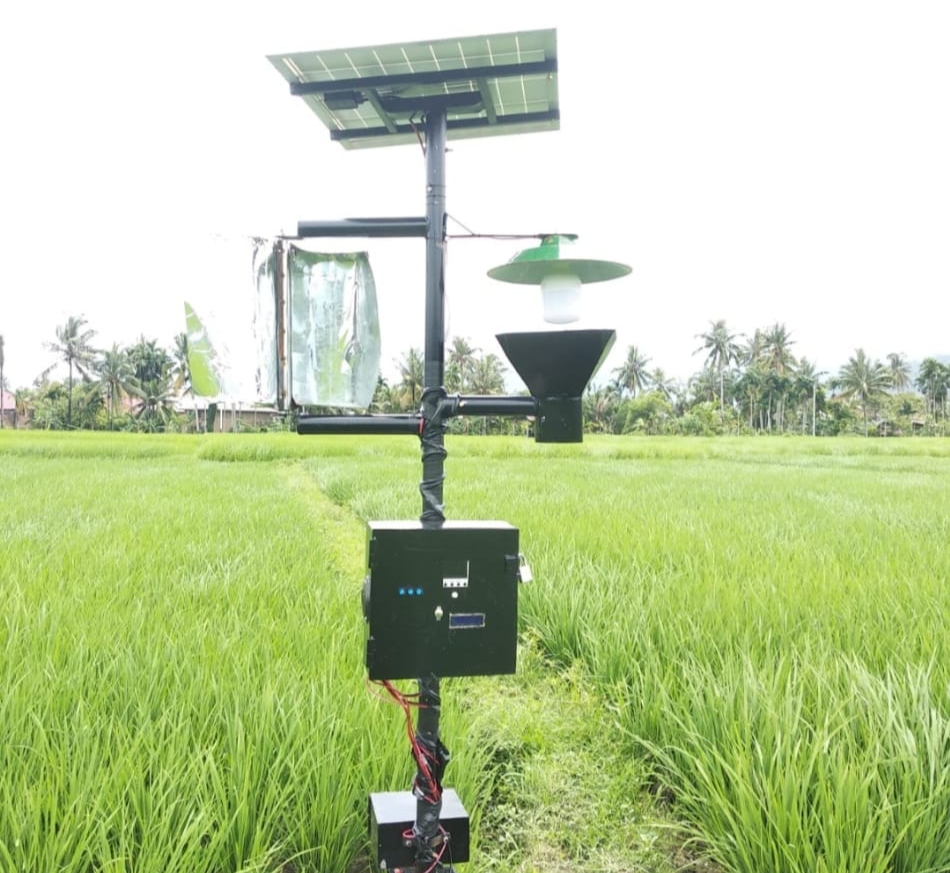
agricultural innovation called Agraris, an automatic rice pest repellent
device designed to help farmers protect paddy fields from pest attacks.
The innovation was tested in the
rice fields of the Cinta Damai Farmer Group in Pisang, Pauh District, Padang
City. Agraris, which stands for Alat Pengusir Hama Padi Otomatis, was
developed in response to a pest outbreak reported at the end of 2020, when 70
hectares of rice fields in Padang were attacked by brown planthoppers, with
Pisang identified as the most affected area. According to Agraris Team Leader
Arif Rahman, pest attacks in Pisang affected around 80 to 90 percent of the
local rice field area, becoming the main reason the team created the device.
Agraris was developed by students
participating in the Independent Project Class, one of the implementations of
the Merdeka Belajar Kampus Merdeka program. The team was led by Arif Rahman
from the Department of Electrical Engineering, Faculty of Engineering, with
members Yolanda Farmayeni from Electrical Engineering, Wahyu Pradana from
Electrical Engineering, Adif Bayu Tirta from Plant Protection, Faculty of
Agriculture, and Ahmad Abel Alfando from Mechanical Engineering. The team was
supervised by Dr. Eng. Muhammad Ilhamdi Rusydi.
The student innovation received
funding through the 2021 Student Creativity Program, a national program of the
Ministry of Education, Culture, Research, and Technology that supports student
creativity across Indonesia. Through this program, the UNAND team developed
Agraris as a practical technology to help farmers manage several types of pests
at once, including birds, brown planthoppers, and rats.
Adif Bayu Tirta explained that
Agraris works by using ultrasonic sound frequencies to repel pests. The device
is also equipped with a lamp and a flock reflector. The lamp is used to help
control brown planthoppers, while the flock reflector repels birds by using
glare from reflected sunlight.
One of the advantages of Agraris is
its semi-portable main frame, making it easier for farmers to move the device
from one location to another. The ultrasonic frequency can cover up to one
hectare of agricultural land. The lamp used to trap brown planthoppers is also
supported by an automatic controller, allowing it to turn on at 6.00 p.m. and
turn off at 6.00 a.m.
The Agraris team has also introduced
and demonstrated the use of the device to farmers from the Cinta Damai Farmer
Group, which serves as the partner for this innovation activity. According to
Adif, the team plans to evaluate and improve the performance of Agraris based
on the needs of the partner farmers. They will also conduct a survey among
members of the farmer group to assess the benefits of the device.
In addition to field testing and
community implementation, the team is also pursuing intellectual property
protection for the innovation. Adif stated that Agraris is being submitted for
patent registration to the Regional Office of the Ministry of Law and Human
Rights in West Sumatra.
This innovation supports SDG 2
Zero Hunger by helping farmers protect rice fields from pest attacks that
can threaten agricultural productivity. By providing a practical tool to manage
pests such as birds, brown planthoppers, and rats, Agraris contributes to
stronger food production and more resilient farming practices.
The initiative also aligns with SDG
9 Industry, Innovation and Infrastructure because it demonstrates how
student-led technological innovation can respond directly to community needs.
Through the development of an automatic, semi-portable agricultural device,
UNAND students show how campus-based innovation can be applied to strengthen
local farming systems.
Through Agraris, UNAND continues to
encourage students to transform ideas into applicable technologies that provide
benefits beyond the classroom. The innovation reflects the university’s
commitment to supporting farmers, advancing agricultural technology, and
contributing to sustainable development through the Merdeka Belajar Kampus
Merdeka and Student Creativity Program platforms.