
UNAND KKN Students Support SDG 11 and SDG 12 through Organic Waste Processing into Compost
Padang, 14 August 2022
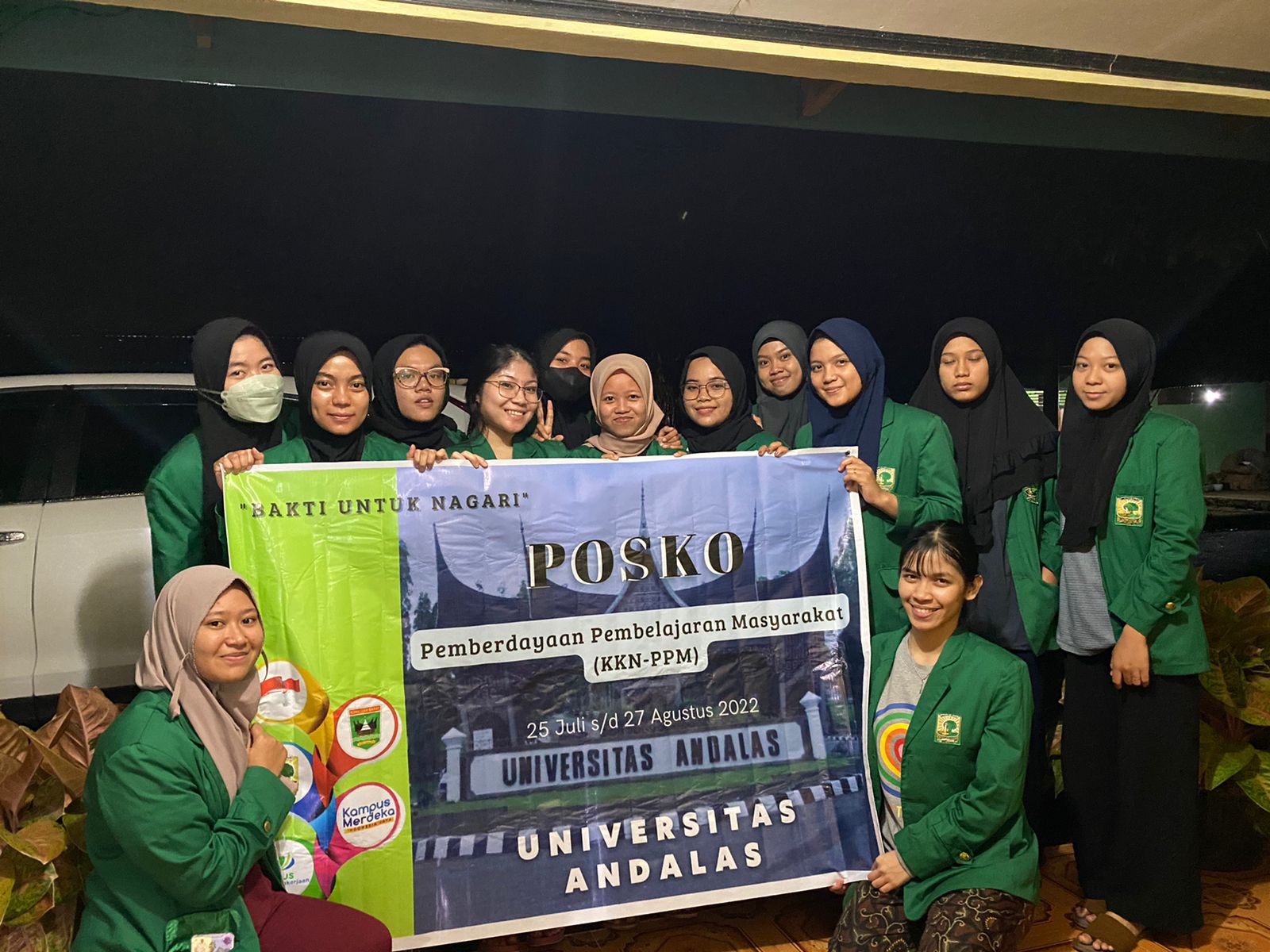
Pesisir Selatan, August 14, 2022 — Universitas Andalas (UNAND) students participating in the
Community Service Program, known as KKN, carried out public education and
practical action on organic waste processing in Nagari Kambang Barat, Pesisir
Selatan. The activity was aimed at helping address the habit of improper waste
disposal while introducing compost production as a useful solution for the
local community.
The activity was written by Rima
Dwisani, a Chemistry student from the Faculty of Mathematics and Natural
Sciences, Universitas Andalas. In 2022, UNAND deployed more than 5,000 KKN
students, including 23 students assigned to Nagari Kambang Barat with academic
backgrounds from various faculties.
During a visit by UNAND KKN students
on August 1, 2022, Jony Marjohan, Head of Kampung Talang in Nagari Kambang
Barat, stated that changing community habits is one of the most difficult
challenges. The issue became clear as students observed that waste remained a
major problem in the area. Some residents usually disposed of waste behind their
homes, in bushes, or near rivers, while others buried or burned accumulated
waste.
Nagari Kambang Barat has a
population of 10,900 people and consists of five kampung, namely Tebing Tinggi,
Pasar Kambang, Pasar Gompong, Rangeh, and Talang. According to the Nagari
Secretary, Drs. Yusman, most residents work as fishermen, farmers, livestock
breeders, and plantation workers. In Kampung Talang, many residents are
farmers, followed by Rangeh and Tebing Tinggi, which are located on relatively
higher land.
The unmanaged waste problem has
caused several environmental concerns, including unpleasant odors, soil
pollution, air pollution, and river contamination. Waste thrown into rivers can
also contribute to flooding, while waste piles may become breeding grounds for
pathogenic microorganisms that can harm humans and animals. Decomposing waste
produces unpleasant gases and leachate that may pollute wells, rivers, lakes,
and groundwater.
Responding to these conditions,
UNAND KKN students initiated an activity to turn waste into something useful
and environmentally beneficial. The students encouraged waste separation into
organic and inorganic categories. Inorganic waste can be recycled, while
organic waste can be processed into compost, which is particularly useful for
farmers, one of the largest occupational groups in Nagari Kambang Barat.
Compost was introduced as a product
of organic matter decomposition that can help improve soil fertility and
provide nutrients for plants. Jony Marjohan noted that compost production is
very helpful for farmers, especially as the price of NPK fertilizer had reached
nearly one million rupiah per unit and had doubled due to the impact of the
COVID-19 pandemic.
The compost-making activity was
carried out by collecting organic waste from several households in Kampung
Talang, Rangeh, and Tebing Tinggi. The students also collected locally
available natural materials such as dry leaves, straw, and cow manure. These
materials were then chopped into smaller pieces to support a better fermentation
process and improve compost quality.
The organic materials were mixed
with dried cow manure, which helps introduce microorganisms for decomposition.
The process was accelerated by adding M4, which also provides nutrients for
microorganisms. After mixing, the compost material was tightly covered to
prevent air from disturbing the composting or fermentation process. The
fermentation process takes around 15 to 20 days, and the material should be
stirred every three days to support complete fermentation.
Kelpin, a UNAND KKN student from the
Department of Agricultural Technology, explained that mature compost can be
identified by its dark brown to blackish color, a temperature close to the
initial composting temperature and not exceeding 50°C, an earthy smell rather
than a rotten odor, and a volume reduction of around 20 to 40 percent depending
on the maturity level. If the volume reduction is still small, the composting
process is not yet complete.
This community activity supports SDG
11 Sustainable Cities and Communities by encouraging cleaner settlements,
reducing improper waste disposal, and helping prevent environmental problems
such as polluted drainage, dirty surroundings, and flood risks. Through
education and direct action, UNAND KKN students helped build community
awareness of the importance of managing household waste properly.
The activity also contributes to SDG
12 Responsible Consumption and Production by transforming organic waste
into compost that can be reused for agriculture. This approach promotes waste
reduction, resource recovery, and more responsible household and farming
practices in Nagari Kambang Barat.
Through this KKN program, UNAND
students demonstrated how community-based education can turn a local
environmental problem into a practical opportunity. By converting organic waste
into compost, the initiative not only helps reduce pollution but also supports
farmers with an alternative source of soil nutrients.