
UNAND, ITB, and PT Semen Padang Support SDG 8 and SDG 12 through Regenerative Agriculture for Post-Disaster Economic Recovery
Padang, 20 April 2026
Padang,
April 20, 2026 —
Universitas Andalas (UNAND), together with Institut Teknologi Bandung (ITB) and
PT Semen Padang, supported a community empowerment program to strengthen the
economic recovery of residents living in the permanent housing area of Kampung
Talang, RT 03 RW 04, Kapalo Koto Village, Pauh District, Padang.
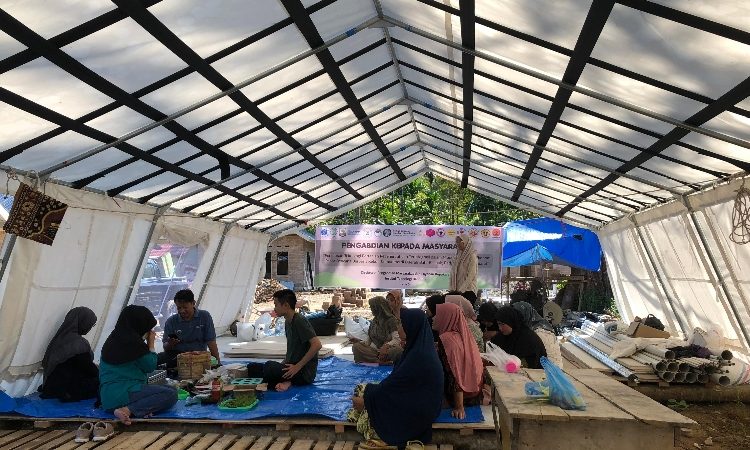
The community service program
carried the theme “Application of Regenerative and Integrated Agricultural
Technology in a Community Garden-Based Post-Disaster Economic Recovery Model.”
The activity was designed as a strategic effort to help residents build
economic independence through sustainable agriculture that can be applied even
in limited land areas.
Head of the ITB Community Service
Team, Ramadhani Eka Putra, explained that the program was a continuation of
previous interventions that focused on providing healthy and proper temporary
housing after the disaster. As the post-disaster situation became more stable,
the focus shifted toward strengthening residents’ livelihoods and ensuring that
the community could develop sustainable sources of income.
The program was not designed as a
short-term training activity only. Instead, it will continue with mentoring
until November 2026, during which the ITB team will monitor the implementation
process in the field. This assistance is expected to strengthen community
capacity, especially among housewives, in transforming available resources into
economic value.
Residents received various practical
training materials, including hydroponic farming techniques as a solution for
limited land, galo-galo or Trigona bee cultivation, and the distribution of
productive plant seedlings such as coconut and durian. The program introduced
the concept of home yards as a “living refrigerator,” where household spaces
can be used to support independent food needs.
PT Semen Padang provided concrete
support through organic fertilizer made from maggot-based waste processing,
known as kasgot. The fertilizer is considered useful for improving
planting media while also supporting circular economy principles. Corporate
Secretary of PT Semen Padang, Win Bernadino, stated that the company’s
involvement was part of its Social and Environmental Responsibility commitment
to accelerate the recovery of disaster-affected communities and strengthen residents’
independence.
Fajar Rahmadoni from PT Semen
Padang’s Social and Environmental Responsibility team added that the company’s
support was not limited to material assistance. Through kasgot
fertilizer, the program also encourages sustainable agricultural practices at
the community level and educates residents on organic waste management that can
generate economic value.
From UNAND, Head of the Department
of Biology, Faculty of Mathematics and Natural Sciences, Henny Herwina,
emphasized the importance of maintaining economic activities among
post-disaster communities. She appreciated the involvement of various parties
in presenting practical, science-based solutions that are easy for residents to
apply, including galo-galo cultivation, chicken farming, and hydroponic
systems.
The community showed strong
enthusiasm during the training. One resident, Ema, said the activity provided
new knowledge and opened opportunities for families to increase income and meet
daily needs. With the synergy between ITB, UNAND, PT Semen Padang, and other
supporting institutions, Kampung Talang is expected to grow not only as a
post-disaster relocation area, but also as a model for independent economic
development based on regenerative agriculture in an urban setting.
This initiative supports SDG 8
Decent Work and Economic Growth by helping disaster-affected residents
rebuild livelihoods through practical training, community-based
entrepreneurship, and household-level income opportunities. By focusing on
hydroponics, bee cultivation, productive plants, and integrated agriculture,
the program encourages inclusive economic recovery.
The program also aligns with SDG
12 Responsible Consumption and Production because it promotes the use of
organic waste-based fertilizer and circular economy practices. Through kasgot
fertilizer and regenerative agriculture, residents are introduced to a more
sustainable way of producing food while managing waste as a resource.
Through this collaboration, UNAND
reaffirmed its role in bringing science-based solutions closer to communities.
The partnership with ITB, PT Semen Padang, and local residents shows how
post-disaster recovery can move beyond housing assistance toward long-term
economic resilience, sustainable agriculture, and community independence.